
Our paper has been accepted to ICLR 2026!
Published:
Paper Accepted by ICLR 2026
We are pleased to announce that our latest research paper on 3D Gaussian Splatting (3DGS) optimization has been accepted by ICLR 2026 (International Conference on Learning Representations), a top-tier conference in machine learning and computer vision.
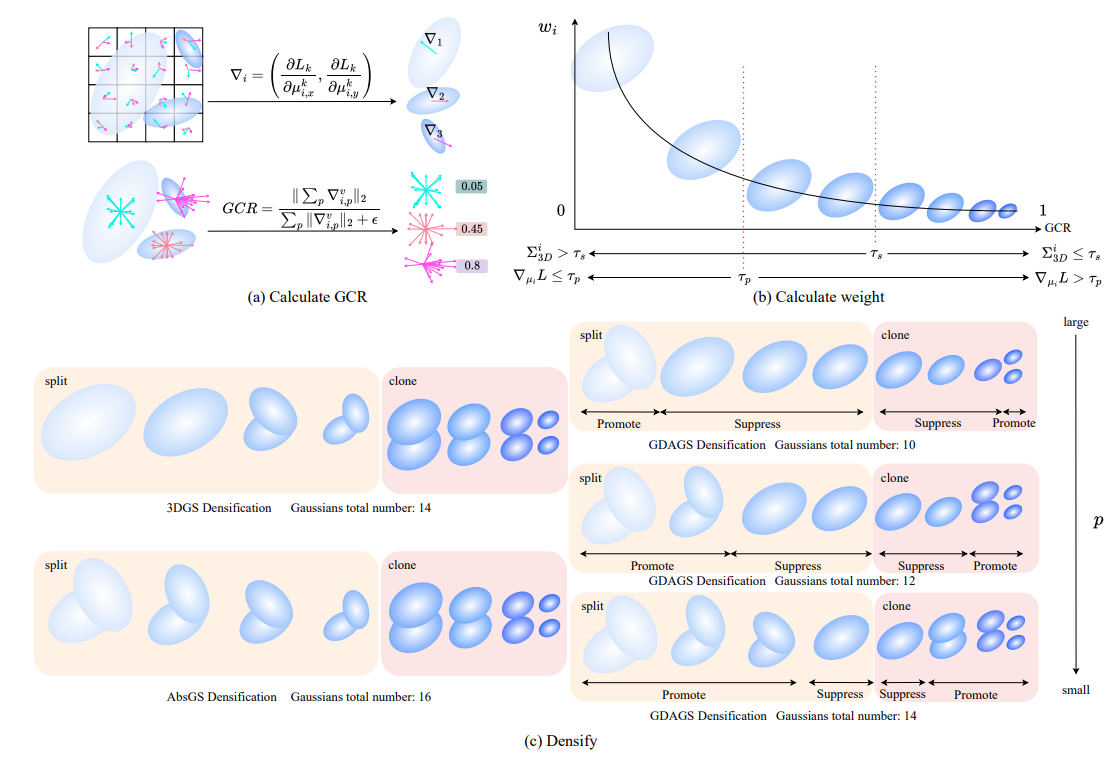
Research Overview: While 3D Gaussian Splatting has significantly advanced Novel View Synthesis (NVS) with real-time photorealistic rendering, existing methods face critical limitations in complex scenarios. Specifically, they often suffer from (1) Over-reconstruction, where conflicting gradient directions prevent effective splitting of large Gaussians, leading to blurry areas; and (2) Over-densification, where aligned gradient aggregation causes redundant component proliferation, significantly increasing memory overhead.
To address these challenges, we propose Gradient-Direction-Aware Gaussian Splatting (GDAGS). Our key innovations include:
- Gradient Coherence Ratio (GCR): A novel metric computed through normalized gradient vector norms to explicitly discriminate between Gaussians with concordant versus conflicting gradient directions.
- Nonlinear Dynamic Weighting Mechanism: A strategy that leverages GCR to enable gradient-direction-aware density control. GDAGS prioritizes splitting for conflicting-gradient Gaussians to enhance geometric details while suppressing redundant densification in concordant-direction regions.
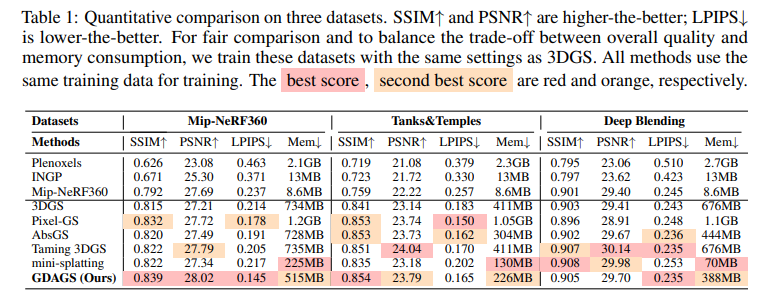
Results: Comprehensive evaluations across diverse real-world benchmarks (including Mip-NeRF360, Tanks&Temples, and Deep Blending) demonstrate that GDAGS achieves superior rendering quality compared to state-of-the-art methods. Furthermore, it effectively mitigates over-reconstruction and over-densification, constructing compact scene representations with reduced memory consumption.
Paper Details:
- Title: Gradient-Direction-Aware Density Control for 3D Gaussian Splatting
- Conference: ICLR 2026
- Authors: Zheng Zhou, Yu-Jie Xiong* (Corresponding Author), Jia-Chen Zhang, Chun-Ming Xia, Xihe Qiu, Hongjian Zhan
- Affiliations: Shanghai University of Engineering Science, East China Normal University
Links: